Tableaux

Using our bodies to make a ‘living picture’.
 

What is it?

Tableau is a tool that gets students exploring topics, stories, characters, themes, and more with their bodies and voices before delving into the content. You can use tableaux in the classroom as both an artistic exploration and a bridge to academic content. The word ‘tableau” comes from the French term ‘tableau vivant’ which means living picture.

In a tableau, actors pose their bodies silently to represent a moment from a scene or a story.
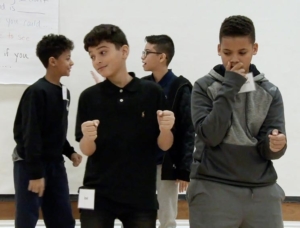
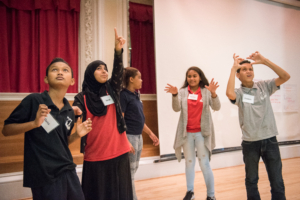
Four middle students are in a scene on the stage of a school auditorium. One of the students in the front is pantomining holding a steering wheel. The student next to him holds his hand near his mouth as if speaking into a handheld radio.

Elements of Tableau

  • Shape
  • Spacing
  • Levels
  • Characters/objects & relationships
  • Environment/Setting
  • Physical Expression & Gesture
  • Facial Expression


Collaboration with members of the group is essential.

Basic Tableau Steps

Step 1:

  • Show the students pictures and ask them to tell you what they see/notice.
  • Start with something simple & accessible: A Forest, A Beach, A Classroom
  • Try showing several images of the same thing – so students understand there isn’t one specific way to make a ‘forest’.
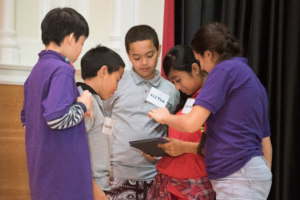
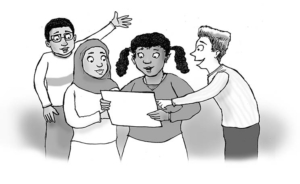
Five middle school students, standing in a tight group, looking at and gesturing towards an iPad.

Step 2:

  • Have a small group of students to recreate that image with their bodies in front of rest of the class.
  • They can add on one at a time.
  • Encourage them to consider: levels, shape, spacing, characters/objects, expressions
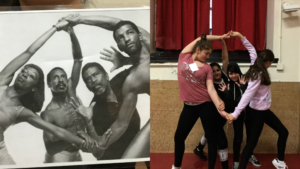
There are two images side-by-side. The first is a black and white photo of professional dancers creating a tableau with their bodies. The second is of a small group of middle school students recreating the same pose.

Step 3:

  • Ask the audience:
    • What do you see and what does that make you think? “I see Jenny has their hands way up into the air – one is curled and one is straight. That makes me think they are a tree”
    • Is the story and setting is clear?
    • What could be adjusted to make it clearer?
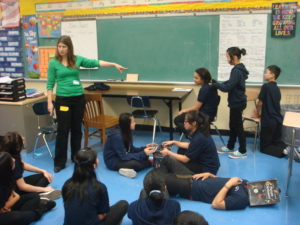
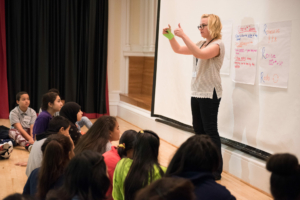
In a classroom, a teaching artist is pointing with her left hand at three students in a theater tableau. The three students are in a line: one is seated, the next is standing behind her holding her ponytail and the third is kneeling behind. In the foreground, two students are seated cross-legged facing each other and stacking books and one student is laying on her back with a book covering her face. Additional students are seated as an audience and looking at the tableau.

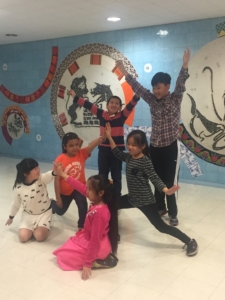
Six students in a school hallway with a colorful mural behind them. They are creating a group pose. All have their arms extended. Two are kneeling. Two are lunging. Two are standing up straight.

Step 4:

  • Give the small groups of students something to make a tableau of (ex: setting, replicating a picture, scenario)
  • Remind students of the elements of a tableau. Have the students practice making their own tableau in small groups.
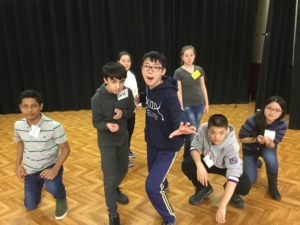
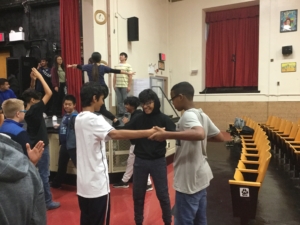
Seven middle school students on an auditorium stage are all leaning toward the camera. Two are lunging. Two are crouching. One is kneeling.Three middle school students are holding hands and standing in a circle in a school auditorium.

Step 5:

  • Each group shares out.
  • The audience describes what they see: I notice… I see _____ which makes me think…
  • Optional: The students in the audience guess what’s being shown.
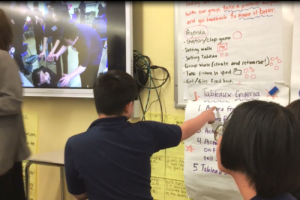
Back of a middle school student's head as he points to a chart labeled "Tableaux Criteria." To his left is a smartboard with a paused video of fellow students acting a scene.A teaching artist stands in front of a class of students seated on an auditorium stage. The artist shows two thumbs up to the class.

Why does Tableaux work?

  • Engages embodied cognition.
  • It is a concrete way to talk about creating a stage picture that tells a story.
  • It is a collaborative experience, students to work together so one student is not put on the spot. Any student can do it! Even one who is nervous about speaking English.
  • It’s fun and gets reluctant students on their feet and participating right away.
  • It can be used as a bridge to scene work, academic learning, and language acquisition.
  • Arts learning is in the Engagement Zone – both supported and rigorous.
  • Playful approach lowers the affective filter.
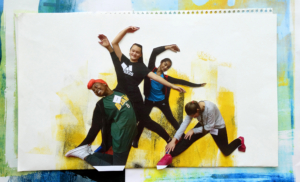
Four students pose with their bodies in dance shapes. Two are standing with one arm extended and one arm curved. One is kneeling with one arm extended up and one reaching back to her feet. One student is kneeling on one leg with her other leg extended on the floor. She is reaching both arms to that leg and her head is down.

Going Deeper with Tableau

Focus on Creating a Story

  • Have students make 3 tableaux that show the beginning, middle and end of a story (this could be generated or re-telling) that can be turned into a scene.
  • This also allows you to introduce the idea of a conflict (problem) that presents itself in a story.

Five middle school students stand on a stage. One is gesturing with her hands as if she is directing the others. The other students are in a tableau, all looking up.

Art As Text

  • Use an Image or Art Work as a jumping off point
  • Use Art as Text strategy to look deeply at the image (Tip: choose an image from a connected curriculum)

A cartoon of 4 students gather to look at a rectangular image.

Add Speech

  • Use the Speech Bubble strategy to add speech or sounds to the tableau.
  • Tell the students to think about what their character is thinking/feeling.
  • Give them some time to generate ideas – check in to make sure students have a plan (if needed before they are in the tableau have them brainstorm ideas together.)
  • While students are in the tableau, tap each one on the shoulder so they can say their line.
  • Alternatively get ideas from the audience.

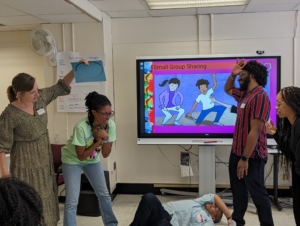
Teachers pose in a tableaux facilitator holds a speech bubble above one teacher's head


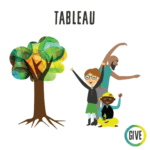
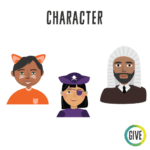
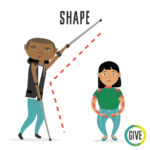
cartoon of 3 characters making a tree with their bodies, next to a treedrawing of trees, buildings, with rain cloud and sun above.one cat character, one pirate character and one judge characterone person with crutches with one arm in air making an angular shape, and one character with their arms in front in circle making a curvy shapetwo people spaced far apartthree folks one on low level, one on medium level, and one on high level

Close