What is it?
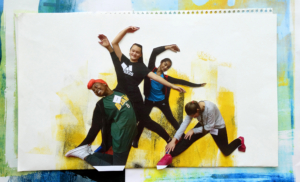
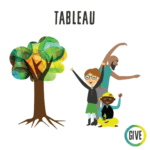
Tableau is a tool that gets students exploring topics, stories, characters, themes, and more with their bodies and voices before delving into the content. You can use tableaux in the classroom as both an artistic exploration and a bridge to academic content. The word ‘tableau” comes from the French term ‘tableau vivant’ which means living picture.
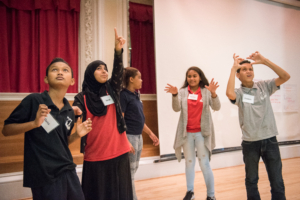
In a tableau, actors pose their bodies silently to represent a moment from a scene or a story.
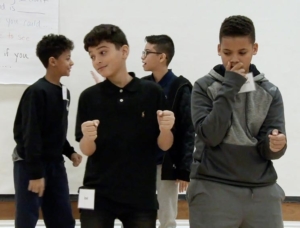
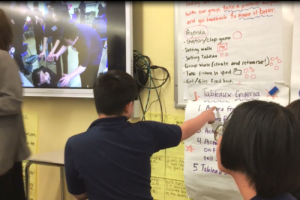
Elements of Tableau
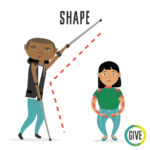
- Shape
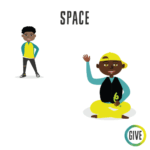
- Spacing
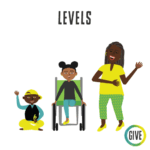
- Levels
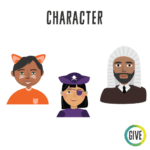
- Characters/objects & relationships
- Environment/Setting
- Physical Expression & Gesture
- Facial Expression
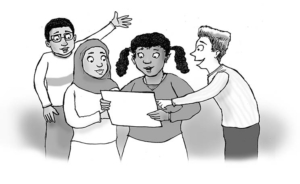
Collaboration with members of the group is essential.
Basic Tableau Steps
Step 1:
- Show the students pictures and ask them to tell you what they see/notice.
- Start with something simple & accessible: A Forest, A Beach, A Classroom
- Try showing several images of the same thing – so students understand there isn’t one specific way to make a ‘forest’.
Step 2:
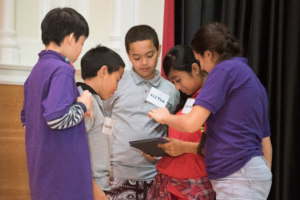
- Have a small group of students to recreate that image with their bodies in front of rest of the class.
- They can add on one at a time.
- Encourage them to consider: levels, shape, spacing, characters/objects, expressions
Step 3:
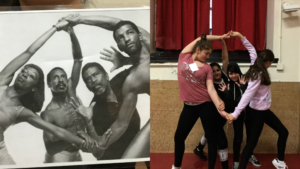
- Ask the audience:
- What do you see and what does that make you think? “I see Jenny has their hands way up into the air – one is curled and one is straight. That makes me think they are a tree”
- Is the story and setting is clear?
- What could be adjusted to make it clearer?
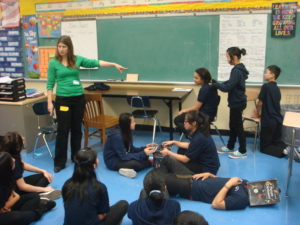
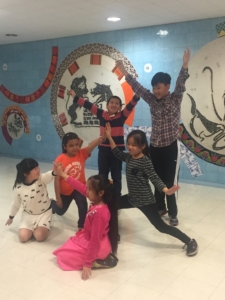
Step 4:
- Give the small groups of students something to make a tableau of (ex: setting, replicating a picture, scenario)
- Remind students of the elements of a tableau. Have the students practice making their own tableau in small groups.
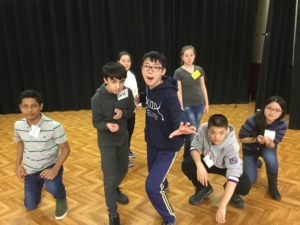
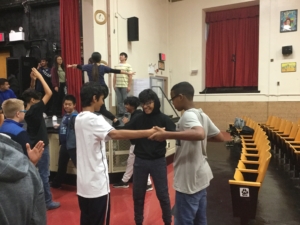
Step 5:
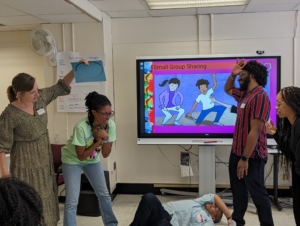
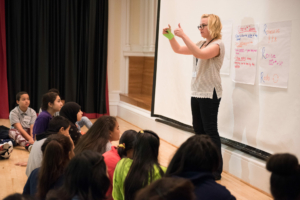
- Each group shares out.
- The audience describes what they see: I notice… I see _____ which makes me think…
- Optional: The students in the audience guess what’s being shown.
Why does Tableaux work?
- Engages embodied cognition.
- It is a concrete way to talk about creating a stage picture that tells a story.
- It is a collaborative experience, students to work together so one student is not put on the spot. Any student can do it! Even one who is nervous about speaking English.
- It’s fun and gets reluctant students on their feet and participating right away.
- It can be used as a bridge to scene work, academic learning, and language acquisition.
- Arts learning is in the Engagement Zone – both supported and rigorous.
- Playful approach lowers the affective filter.